Be it a witty euphemism or a roundabout slap in the face, describing a county jail’s occupants as “comfortably lodged” evokes intriguing thoughts about jailhouse conditions in years past. This term, along with other colloquial language, is sprinkled across regional newspapers detailing the periodic happenings of the local penitentiary and their incarcerated population, but it has also become an accurate way to describe how some communities have transformed their old jails into museums.
Photograph by Austin Allison
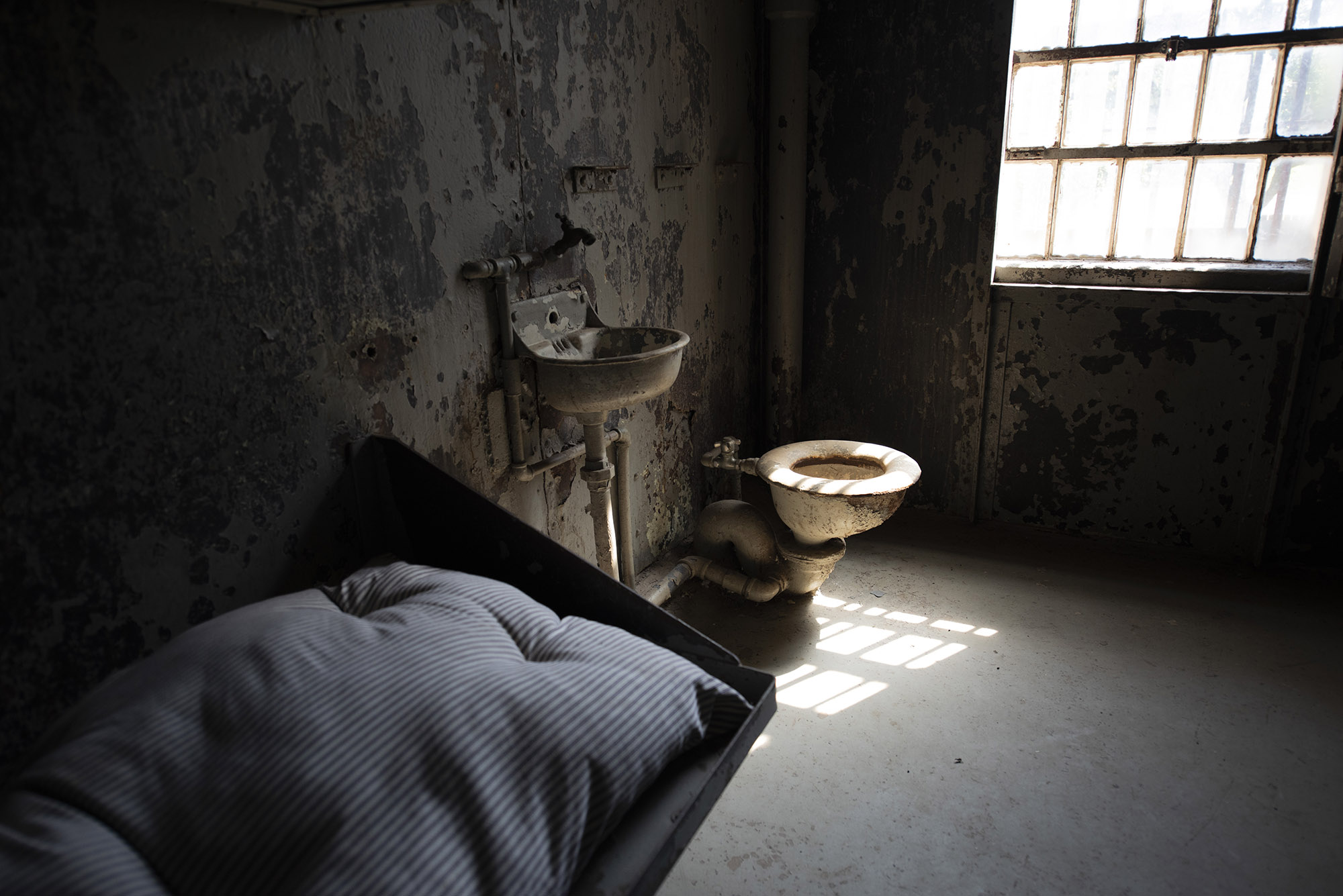
The evolution from lodging inmates to lodging history was not and is not easy, but it embodies a natural progression of these historic structures to assume new roles as cultural heritage centers. From the walls and bars of the structure itself to the inmates confined within, each county jail experienced its fair share of events that shaped the development of a region acting as a symbol of criminal justice to residents and those merely passing by. Stories of a jail’s inhabitants are told through the iron, concrete or plaster walls that bear their etchings, and tales of daring jail escapes are illustrated by repaired patches on the walls.
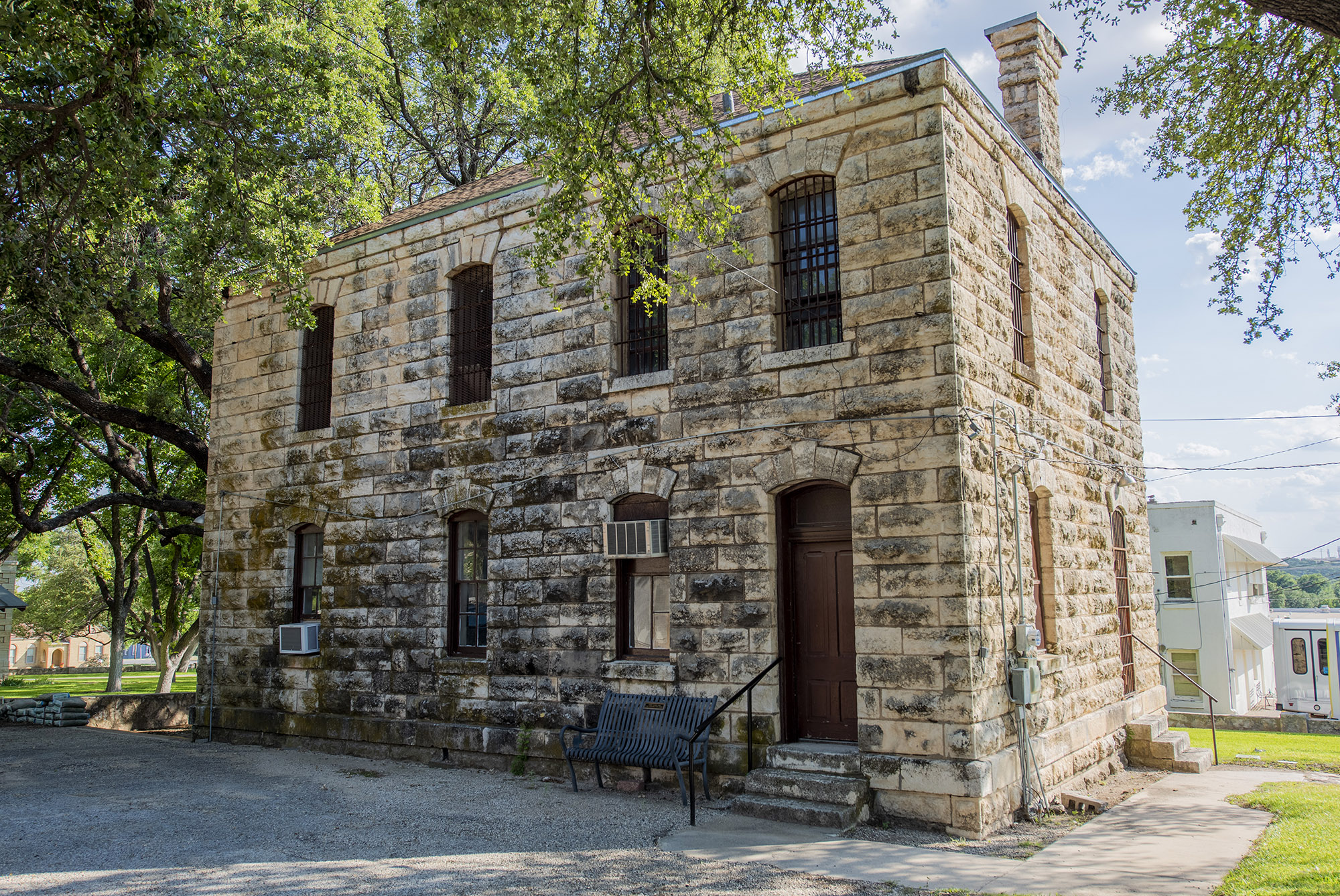
Sutton County’s 1891 jail in Sonora is a fine example of an early West Texas jail that experienced a vast transformation from the rugged and often violent frontier of the late 1800s to the more settled community known today. Constructed by the Pauly Jail Building and Manufacturing Company of limestone cut from the same quarry as the adjacent courthouse, tracing its history relies on surviving historic documents, historic markers, and firsthand accounts of the jails' use from 1891 up to 1980.
Photograph by Austin Allison
Sonora became the county seat of Sutton County in 1890, but it would take nearly a year for a county jail to be built. Presented with this early quandary, law enforcement officials utilized a tree to anchor accused criminals. By the end of 1891 three institutions came to Sonora: The Devil’s River News, the 1891 Sutton County courthouse and the county jail. Each of these survives today and offers a share of the story of the county jail. Sonora’s Devil’s River News contains a wealth of information about the early era of the jail and its first inmates.
The jail’s first two inmates were notable. Both arrested for murder, John Denson and T. C. Adams are listed in the newspaper as the jail’s first two inhabitants in October 1891. One decade later in 1901 another noted gunman and desperado, Will Carver, found himself in the jail, not as an inmate, but in the jail’s morgue following a shootout with the Sutton County sheriff.
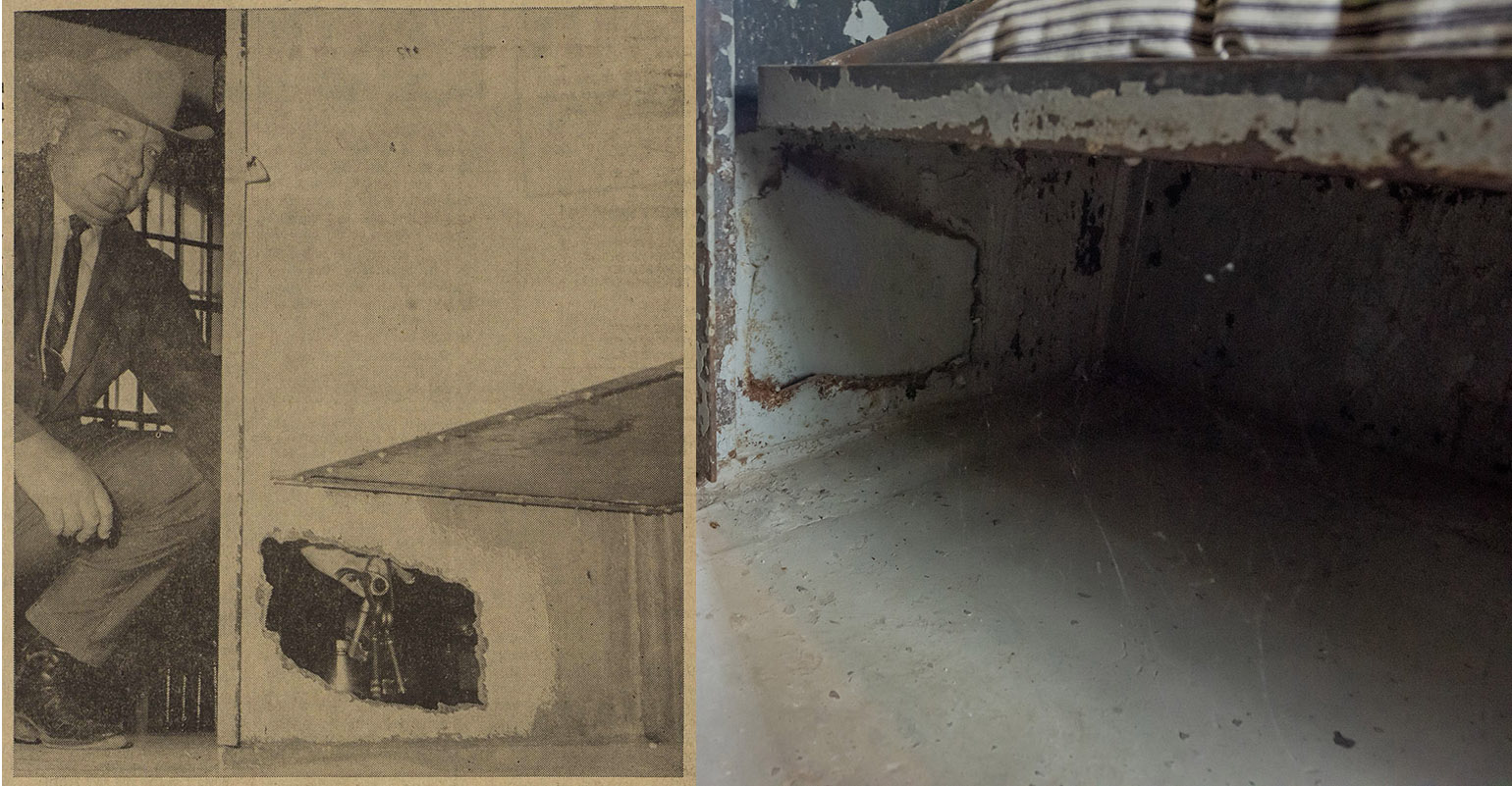
Scouring the crisp pages of historic newspapers provides interested parties contemporaneous accounts of the jail, but they also shed light on remnants of a jail’s occupation. Elaine Donaldson of the Sutton County Historical Society relayed the story of a 1969 jailbreak that was executed with a hijacked pair of bolt cutters that a trustee snuck into his cell to bust through the steel wall of the second floor cell. Although this portal to unearned freedom was quickly patched following the incident, the repaired portion of the wall still serves as an extant structural exhibit highlighting a successfully engineered jailbreak. When I visited the museum in June 2021, Nancy Johnson, also of the Historical Society, helped me locate this patched hole.
Photograph by Austin Allison, and Devil’s River News, 1969
By 1977, the jail had fallen into disrepair and failed standards set by the Texas Jail Standards Commission. Sheriff Bill Webster in a 1977 issue of the Devil’s River News said, “the [old] jail is too small, too old and poorly designed to perform its function today.” Visiting the jail on a climatically normal June morning, the second floor was sweltering and speaks to just one of the standards not met. A new jail was erected by 1980, and county residents began to repurpose the old jail as a museum. The initial effort to convert the jail to a museum did not last long, and the jail was used for storage for more than 30 years. By the mid-2010s, renewed efforts successfully renovated the jail, and it is still a feature on the county’s museum tour.
Clay County’s 1890 jail in Henrietta is another example of a Pauly Jail Building and Manufacturing Company that has found new life as a museum. Much larger than Sutton County’s example, the jail in Clay County was intended to house federal inmates as a federal facility. This never occurred, but remnants of its grand scale persist. A gallows was included in the original construction, but no one ever met their fate there.
As it stands today, the Clay County 1890 Jail Museum houses a variety of exhibits as well as the county’s historic archives, but jail life and the role of housing criminals remains the main focus of the museum. Through multiple capital fundraising efforts in the mid-1990s and late-2000s, the historical society was able to raise one million dollars to restore the jail into a satisfactory museum and archive.
Like many other county jails, the Clay County jail also served as a residence for jailers and sheriffs and their families. Jill Avis, vice president of the Clay County Historical Society, even noted that the sheriff and jailers, or more likely their wives, would cook meals for the inmates and be reimbursed by the county. This area of the museum is furnished to reflect a typical early 20th century residence. Jails are usually considered impersonal, isolated and dreary; the possibility of a home-cooked meal seems like an unexpected positive in a more than negative experience.
Life in a Texas county jail was difficult. Indeed, there wasn’t much life to be had. Whether it was the stifling heat in the summer or the grim conditions of the graffiti-laden cell blocks, inmates knew they were in Texas and they knew they were in jail. As these structures aged and became unusable as functioning jails, local efforts rallied to preserve them. They often represent very early history and architecture of a county. With 254 counties, Texas is home to many jail museums across different landscapes and different genres of Texas history.